


Organizations create and process thousands of documents every year, from invoices and contracts to employee records, purchase orders, and customer files. Each one supports an important business function, yet many organizations still manage documents as individual files instead of treating them as information that moves through an entire lifecycle.
As a result, businesses often invest in cloud storage, collaboration platforms, and security tools but continue to experience the same frustrations, such as employees not finding documents, duplicate files multiplying, approvals stalling, and outdated versions circulating across departments.
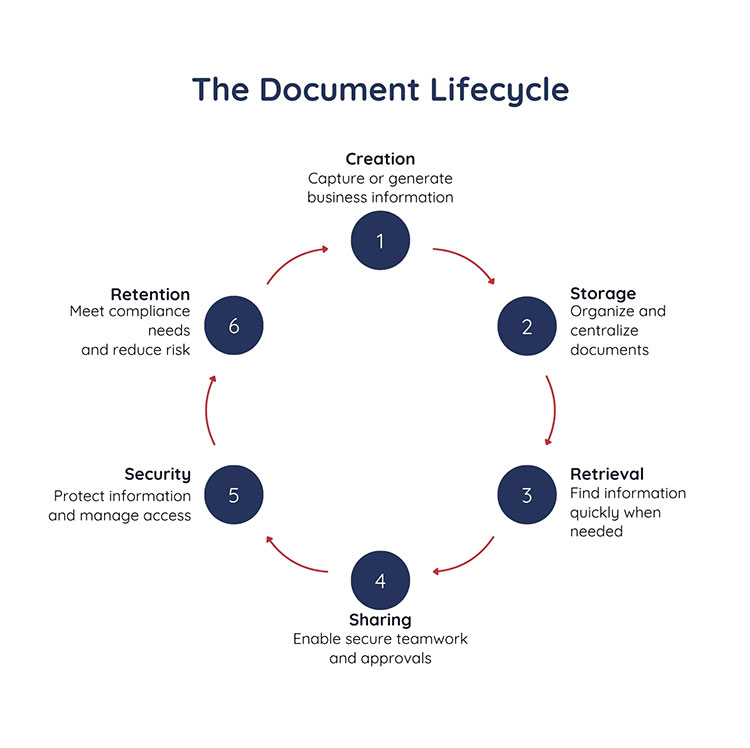
The challenge is how they move from one stage to the next. Every document follows a lifecycle that begins the moment it is created and continues through storage, retrieval, collaboration, security, and eventually retention or disposal. When those stages are disconnected, small inefficiencies accumulate into larger operational problems that affect productivity, compliance, and decision-making.
Every Stage Influences the Next
A document’s lifecycle may appear straightforward, but every stage is dependent on the one before. If a document is created without consistent naming conventions or metadata, it becomes more difficult to organize. When storage practices vary across departments, employees spend more time searching for information than using it. If multiple copies begin circulating through email or shared folders, version control quickly becomes a challenge, making collaboration less efficient and increasing the likelihood of mistakes.
By the time anyone recognizes there is a problem, the issue often appears during retrieval. Employees cannot locate the latest version of a contract, duplicate customer records exist in different systems, or approvals are delayed because the correct document is not readily available. While retrieval becomes the visible pain point, the root cause usually started much earlier in the lifecycle with inconsistent processes surrounding creation and storage.
Rather than viewing these as separate issues, businesses should recognize that document infrastructure functions as one connected system. Weaknesses at the beginning of the lifecycle continue to affect every subsequent stage.
Where Document Infrastructure Breaks Down
Disconnected document environments often create the same operational challenges across industries:
- Documents are stored across multiple repositories with no single source of truth.
- Employees spend valuable time searching for information instead of completing work.
- Multiple versions of the same document circulate between departments.
- Sensitive information remains accessible to users who no longer require access.
- Manual approval processes slow down business operations.
- Documents remain stored long after retention requirements have expired.
These issues create unnecessary friction throughout the organization. Employees lose confidence in the information they are accessing; managers spend additional time verifying documentation, and IT teams are left supporting disconnected systems that were never designed to work together.
Storage is Only Part of the Solution
Many organizations respond to document challenges by expanding storage capacity or migrating files to the cloud. While cloud storage improves accessibility, it does not automatically improve document management. A poorly organized repository remains difficult to navigate regardless of where it is hosted, and simply moving files into a new platform does little to eliminate duplicate documents, inconsistent naming conventions, or fragmented workflows.
Effective document infrastructure focuses on making information usable throughout its lifecycle. Documents should be classified consistently, enriched with metadata, indexed for intelligent search, and stored within centralized repositories that provide a single source of truth. Employees should be able to retrieve information using keywords, customer names, project numbers, or document types instead of relying solely on complex folder structures.
When storage becomes part of a broader document strategy instead of the strategy itself, organizations reduce time spent searching for information while improving overall operational efficiency.
Security Should Travel with the Document
Security is often viewed as a separate layer within IT, but document security should exist throughout the entire lifecycle. As documents move between employees, departments, and applications, organizations need confidence that information remains protected without creating barriers to collaboration.
Modern document infrastructure supports this through role-based permissions, version history, audit trails, and automated governance policies. Instead of relying on employees to manually manage access or determine which version is current, these controls become part of the workflow itself. Teams collaborate more efficiently because everyone works from the same document, while leadership maintains visibility into who accessed information, what changes were made, and when those actions occurred.
Security also extends beyond active documents. Retention schedules, archival policies, and secure disposal processes help organizations meet compliance requirements while reducing unnecessary storage costs and minimizing long-term risk.
A Connected Lifecycle Creates Better Business Outcomes
Organizations that modernize document infrastructure connect every stage of the document lifecycle into a unified process. Documents move seamlessly from capture into centralized storage, workflow automation routes them through approvals, intelligent search makes retrieval nearly instantaneous, and governance policies maintain compliance without requiring constant manual oversight.
The result extends far beyond improved organization. Employees spend less time looking for files and more time completing meaningful work.
Collaboration becomes more consistent because everyone accesses the same information.
Security improves because permissions, version control, and audit trails are built into daily workflows rather than added afterward.
Leadership gains greater visibility into business processes, allowing teams to identify bottlenecks, reduce inefficiencies, and make better-informed decisions.
As organizations continue adopting digital workflows, the volume of business information will only continue to grow. Managing that information successfully requires a document infrastructure that supports the entire lifecycle from creation to secure disposal as one connected process.
When every stage works together, documents become more than records of business activity. They become reliable, accessible, and secure assets that help the organization operate more efficiently every day.